
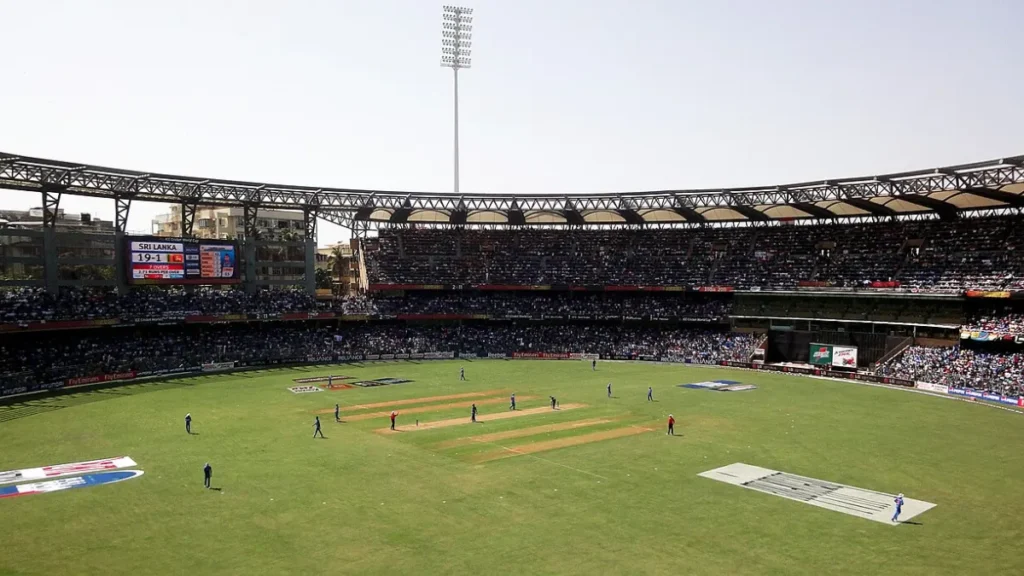
About Wankhede Stadium
Wankhede Stadium Pitch Report: The Wankhede Stadium is located in Mumbai, which is often called the traditional cricket capital of India. Over the years, this ground has hosted some of the most iconic matches in cricket history.
Basic Information
Established: 1974
Capacity: Around 32,000 spectators
Ends: Garware Pavilion End, Tata End
Floodlights: Yes
Home Team: Mumbai
Pitch Type: Grass
One of the interesting things you might notice is that despite being in India, where many pitches support spin, Wankhede often offers something different.
Cricket History of Mumbai Grounds
Mumbai has hosted Test matches at three major venues over the years.
The journey started at the Bombay Gymkhana Ground, which hosted India’s first-ever Test match against England in 1933–34.
After World War II, the Brabourne Stadium became the primary venue and hosted 17 Test matches.
However, due to a dispute between the Cricket Club of India and the Bombay Cricket Association, a new stadium was built. That’s how Wankhede Stadium came into existence, located just a mile away from Brabourne.
Early Matches and Memorable Beginnings
Wankhede Stadium hosted its first Test match in the 1974–75 season when the West Indies toured India.
During that match, Clive Lloyd scored an unbeaten 242, leading his team to a dominant 201-run victory over India, captained by Mansoor Ali Khan Pataudi.
The match was also remembered for crowd disturbance when a fan ran onto the field to greet Lloyd and was handled roughly by the police, creating a tense moment.
India registered its first Test win at Wankhede two seasons later against New Zealand.
Famous Performances at Wankhede Stadium
Over the years, this stadium has witnessed some incredible individual performances.
Sunil Gavaskar scored a brilliant 205 against the West Indies, while Alvin Kallicharran made 187 in the same match during the 1978–79 series.
In 1980, during the Jubilee Test, Ian Botham delivered a legendary all-round performance with a century and 13 wickets, helping England win by 10 wickets.
The highest score by an Indian at Wankhede came from Vinod Kambli, who scored 224 against England in the 1992–93 series, in just his third Test match.
Another remarkable moment came in 1984–85, when Ravi Shastri hit six sixes in an over against Tilak Raj in a first-class match, achieving one of the fastest double centuries at the time.
Overview of Wankhede Stadium
Located in the heart of Mumbai, Wankhede Stadium is one of India’s most iconic cricket venues. It has hosted countless memorable matches, including international games, IPL clashes, and even a historic World Cup final.
What makes this stadium stand out is not just the atmosphere, but also the nature of its pitch. Unlike many other grounds in India that favor spin, Wankhede often behaves differently.
Wankhede Stadium Pitch Report: Nature of the Surface
The Wankhede pitch is generally known to be batting-friendly, especially in limited-overs formats. But there’s more to it than just “good for batting.”
Early Overs: Help for Fast Bowlers
At the start of a match, especially in morning or evening games, fast bowlers tend to get some assistance. The pitch has a bit of bounce and carry, which means:
Seamers can extract movement
Swing bowlers may get help due to coastal humidity
Batsmen need to be careful early on
You might notice that in the first few overs, even top-order players take their time before going aggressive.
Middle Overs: Perfect for Batting
Once the initial movement settles, the pitch becomes much easier to bat on. This is when:
Stroke play becomes easier
Timing improves
Boundaries start flowing
One of the best things about Wankhede is how quickly it transforms from a slightly tricky surface into a batting paradise.
Death Overs: High-Scoring Finish
In the final overs, especially in T20 matches, the pitch offers very little help to bowlers. Combined with short boundaries, this often leads to:
Big hitting
High run rates
Exciting finishes
If you enjoy last-over thrillers, Wankhede rarely disappoints.
How Weather Affects the Pitch
Since Mumbai is a coastal city, weather plays a big role in how the pitch behaves.
Humidity and Dew Factor
Humidity is almost always present, and in night matches, dew becomes a major factor. This can:
Make the ball slippery
Reduce grip for spinners
Help chasing teams
That’s why teams often prefer to bowl first after winning the toss.
Heat and Dry Conditions
During day matches or hotter months, the pitch can dry out a bit, which may:
Slow down the surface slightly
Offer minimal help to spinners
But even then, it rarely turns into a spin-dominant wicket.
Batting vs Bowling: Who Has the Advantage?
If you’re looking at the Wankhede Stadium pitch report from a practical point of view, it generally favors batsmen.
Why Batsmen Love Wankhede
True bounce makes shot-making easier
Ball comes nicely onto the bat
Fast outfield helps boundaries
Even average shots can race to the boundary here, which boosts confidence for batters.
Challenges for Bowlers
Bowlers, especially spinners, often find it tough:
Not much turn available
Short boundaries punish mistakes
Dew reduces control in night games
Fast bowlers still have a chance, but they need to be disciplined with line and length.
Spin vs Pace: What Works Better?
This is where Wankhede becomes interesting.
Pace Bowlers
Fast bowlers generally do better here compared to spinners. They can:
Use bounce effectively
Extract seam movement early
Bowl yorkers in death overs
However, they must avoid predictable lengths.
Spinners
Spinners don’t get much natural help from the pitch. But that doesn’t mean they are useless.
They can still succeed if they:
Bowl tight lines
Vary their pace
Use the bigger side of the boundary
So, skill matters more than conditions for spinners here.
Toss Factor and Match Strategy
The toss plays an important role at Wankhede.
Why Teams Prefer Chasing
Most teams choose to bowl first, and here’s why:
Dew makes bowling second harder
Batting becomes easier under lights
Clear target helps planning
If you’re watching a match here, don’t be surprised if captains consistently opt to chase.
When Batting First Works
Batting first can still be successful if:
The team posts a big total (180+ in T20s)
Bowlers execute well despite dew
Pressure builds on chasing side
So while chasing is preferred, it’s not a guaranteed win.
Wankhede Stadium in T20 Matches
In T20 cricket, Wankhede is known for high-scoring games.
Average Scores
First innings: Around 170–190
Winning scores: Often above 180
You might notice that even a score of 160 can feel below par here.
Fantasy Cricket Tips
If you play fantasy leagues:
Pick top-order batsmen
Choose death-over bowlers
Avoid too many spinners
This pitch rewards aggressive players.
Wankhede Stadium in ODI Matches
In ODIs, the pitch behaves similarly but allows for longer innings.
Key Observations
- Good surface for building innings
- Big scores (300+) are common
- Early wickets can change momentum
Batsmen who settle in can play long, impactful innings here.
Wankhede Stadium in Test Matches
Test cricket at Wankhede is slightly different.
Day-by-Day Behavior
Day 1–2: Good for batting
Day 3: Balanced
Day 4–5: Some help for spinners
Unlike T20s and ODIs, the pitch slowly wears out, bringing spinners into the game later.
Famous Matches at Wankhede Stadium
Wankhede has seen many historic moments. One of the most unforgettable was during the ICC Cricket World Cup 2011 Final, where India national cricket team lifted the trophy.
That match perfectly showcased the nature of the pitch-good for batting, but still competitive enough to keep things interesting.
Unique Features of the Wankhede Pitch
What makes Wankhede different from other Indian grounds?
Consistent Bounce
Unlike many subcontinental pitches, Wankhede offers consistent bounce. This helps:
Fast bowlers early
Batsmen play confident shots
Fast Outfield
The outfield is quick, which means:
Even mistimed shots can reach the boundary
Fielders need to be sharp
Smaller Boundaries
Compared to some other stadiums, boundaries here are shorter, adding to high scores.
Tips for Understanding Pitch Reports Better
If you’re new to cricket or pitch analysis, here are a few simple tips:
Look at previous match scores at the venue
Check weather conditions before the game
Notice team combinations (extra batsmen or bowlers)
Over time, you’ll start predicting how a pitch might behave.
Read Also: Eden Gardens Pitch Report 2026: A Complete Guide to Researched Pitch Reports for Cricket Lovers
Conclusion: on Wankhede Stadium Pitch Report
The Wankhede Stadium pitch report tells a simple story-this is a venue that loves action. Whether it’s fast bowlers getting early movement or batsmen smashing sixes in the final overs, there’s always something happening.
If you enjoy high-scoring games, dramatic finishes, and lively cricket, Wankhede is one of the best places to watch the sport.
And the next time you hear someone talk about the pitch here, you’ll know exactly what they mean-and maybe even predict how the match will unfold.