
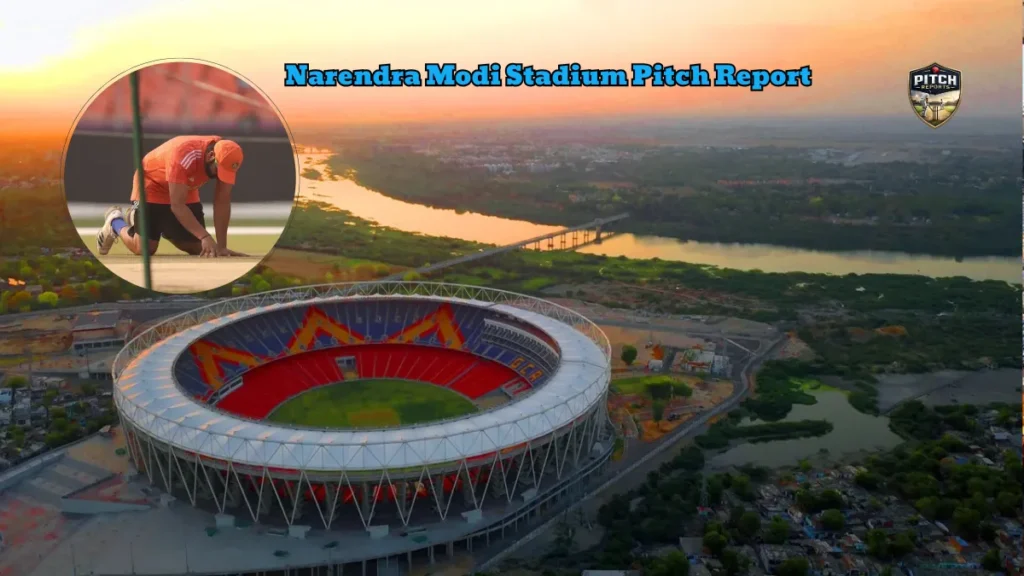
Hello friends! Today, we will learn about the Ahmedabad Narendra Modi Stadium and Narendra Modi Stadium Pitch Report. We hope you find this information interesting and that this article provides you with valuable and accurate insights., located on the banks of the Sabarmati River in Ahmedabad, is one of the world’s largest and most famous cricket venues. Formerly known as the Sardar Patel Stadium, it is often referred to as Motera. The ground has undergone significant transformation over the past few decades.
Built in 1982, the stadium has evolved from a simple venue to the world’s largest cricket stadium, now seating approximately 132,000 spectators. Modern infrastructure, including advanced floodlights and upgraded facilities, makes it a prominent venue for international matches and the Indian Premier League (IPL). The stadium is also home to Gujarat’s domestic teams and regularly hosts major matches.

A Historic Place with Memorable Matches
Over the years, the stadium has witnessed many historic cricket moments. Legendary Indian cricketer Sunil Gavaskar reached the milestone of 10,000 Test runs here during a match against Pakistan in the 1986-87 season. A few years later, Kapil Dev surpassed Richard Hadlee to become the leading wicket-taker in Test cricket at the time, adding another memorable chapter to this venue.
Although the pitch initially favored bowlers, especially in the early years, conditions gradually changed. Matches often slowed down, leading to many draws, until the advent of more productive surfaces in later years.
Narendra Modi Stadium Pitch Report (2026)
In 2026, the Narendra Modi Stadium pitch has emerged as one of the most balanced playing surfaces in the tournament. It offers opportunities to both batsmen and bowlers, leading to contested and interesting matches.
Batting Conditions and Scoring Facts
This season, the pitch has supported strong batting performances, with an average first innings score of around 185 and a run rate of around 9.3 runs per over. However, unlike traditionally flat batting tracks, this surface requires application and shot selection.
Batsmen benefit from the consistent bounce provided by the red soil, allowing them to play aggressive strokes with confidence. Nevertheless, scores over 180 are more competitive than definitive match-winners, adding a strategic layer to the match.
Bowling Impact: Pace Dominates Early
Fast bowlers have found considerable success at this venue in IPL 2026, accounting for over 67% of the total wickets. The new ball offers good bounce and carry, which benefits bowlers who maintain a disciplined length.
Players like Josh Hazlewood and Kagiso Rabada are particularly suited to these conditions, as they can capitalize on the initial movement and extract bounce effectively.
Spin Comes Into Play
As the match progresses, the black soil areas of the pitch begin to influence play. These areas slow down, providing grip and turn for spinners, especially in the middle and death overs. This change ensures that bowlers remain productive not just at the start but throughout the innings.
Also Read: Eden Gardens Pitch Report 2026: A Complete Guide to Researched Pitch Reports for Cricket Lovers
Pitch Structure and Match Dynamics
A distinctive feature of the Narendra Modi Stadium pitch is its mix of red and black soil. This combination creates a dynamic surface:
Red soil provides bounce and pace, which facilitates stroke play initially.
Black soil slows down the surface, which favors spin and variation later on.
Unlike venues like the Wankhede Stadium, where high-scoring games are common, Ahmedabad offers a more balanced contest. Even teams scoring between 170 and 180 can successfully defend totals if they bowl with discipline, especially in the middle overs.
Another important factor is the size of the boundaries. Square boundaries range from 61–67 meters, making them significantly shorter than straight boundaries, which extend up to 89 meters. Because of this, batsmen often target the leg side to maximize scoring opportunities.
Also Read: Wankhede Stadium Pitch Report: Complete Details of the Iconic Mumbai Ground
Weather and Toss Factor
Ahmedabad’s late April weather plays a minor role in match outcomes. Daytime temperatures can reach 41°C, dropping to around 32°C in evening matches. This temperature change often leads to light dew formation in the second innings. Therefore, captains winning the toss may choose to bowl first to take advantage of better bowling conditions initially and ease batting under the lights later.
What to Expect
Overall, the pitch at the Narendra Modi Stadium in IPL 2026 is expected to be a well-balanced contest between bat and ball. Teams scoring totals over 180 runs are generally in a strong position, but even slightly lower scores can be salvaged with good bowling.